
Executive summary
The “video deficit” literature shows that young children often learn less from video than from face-to-face presentations. This is highly relevant to Early Academy because it argues against presenting the product as a self-contained video teacher.
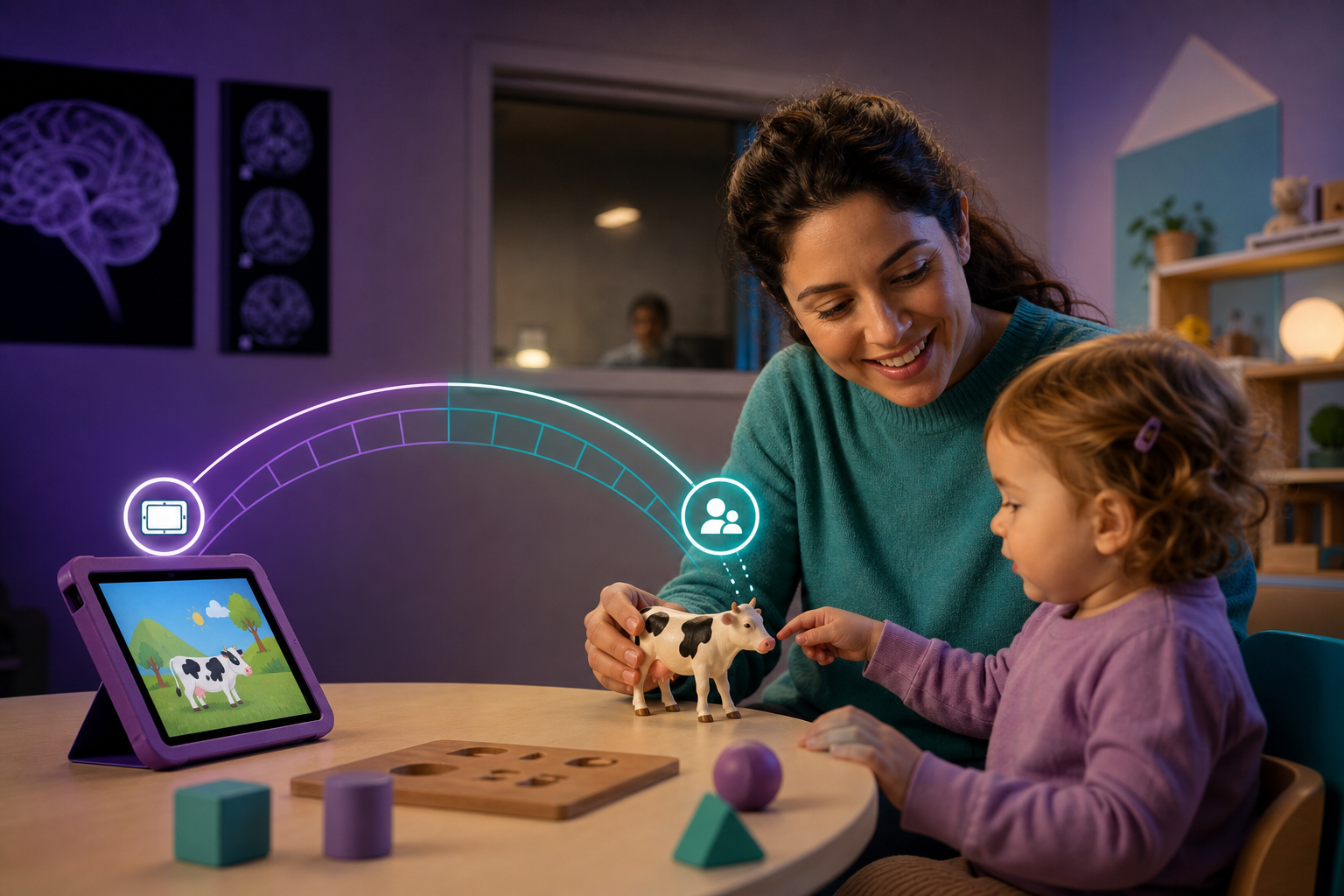
Instead, the correct model is a technologically enhanced storybook. The screen provides polished artwork, professional narration, subtle animation loops, and discoverable audio interactions. The adult provides responsiveness, emotional attunement, clarification, and the real-world bridge young children often need.
This is why Early Academy can allow independent exploration while still recommending adult guidance, especially for younger children. Independent exploration can be enjoyable and familiarizing; guided exploration is more likely to become language-rich and socially meaningful.
What the study found
Across 122 effect sizes from 59 reports, young children learned less from video than from face-to-face presentations on average.
The deficit was larger for younger children and decreased with age.
The findings are consistent with multiple mechanisms, including transfer difficulty from 2D media to real-world understanding.
How this supports Early Academy
Early Academy treats the screen as a picture-book surface, not the teacher. The learning engine is the adult-child interaction around the story.
The product should not claim that animated pages alone teach like a human adult.
The product should emphasize that it gives families a high-quality shared story surface.
The adult-child interaction around the story is a key part of the intended learning context.
Product implications
Do not design as a replacement caregiver
The app should support adults, not imply that adults are unnecessary.
Build bridges from screen to world
Story prompts should ask children to connect scenes to real objects, feelings, routines, family members, and familiar experiences.
Support older and younger children differently
Younger children should be especially encouraged to use stories with an adult; older children may benefit from more independent exploration.
Interpretation and limitations
The video deficit literature covers many forms of video and learning tasks, not Early Academy specifically.
The evidence does not mean video cannot support learning; it means design should account for the gap between screen presentation and live social interaction.