
Executive summary
The important lesson from technology-enhanced storytelling research is that the value of the screen depends on what the screen does to the adult-child interaction. If the media displaces conversation, it is likely working against the child’s learning environment. If it scaffolds shared attention, naming, and discussion, it can become a useful support.
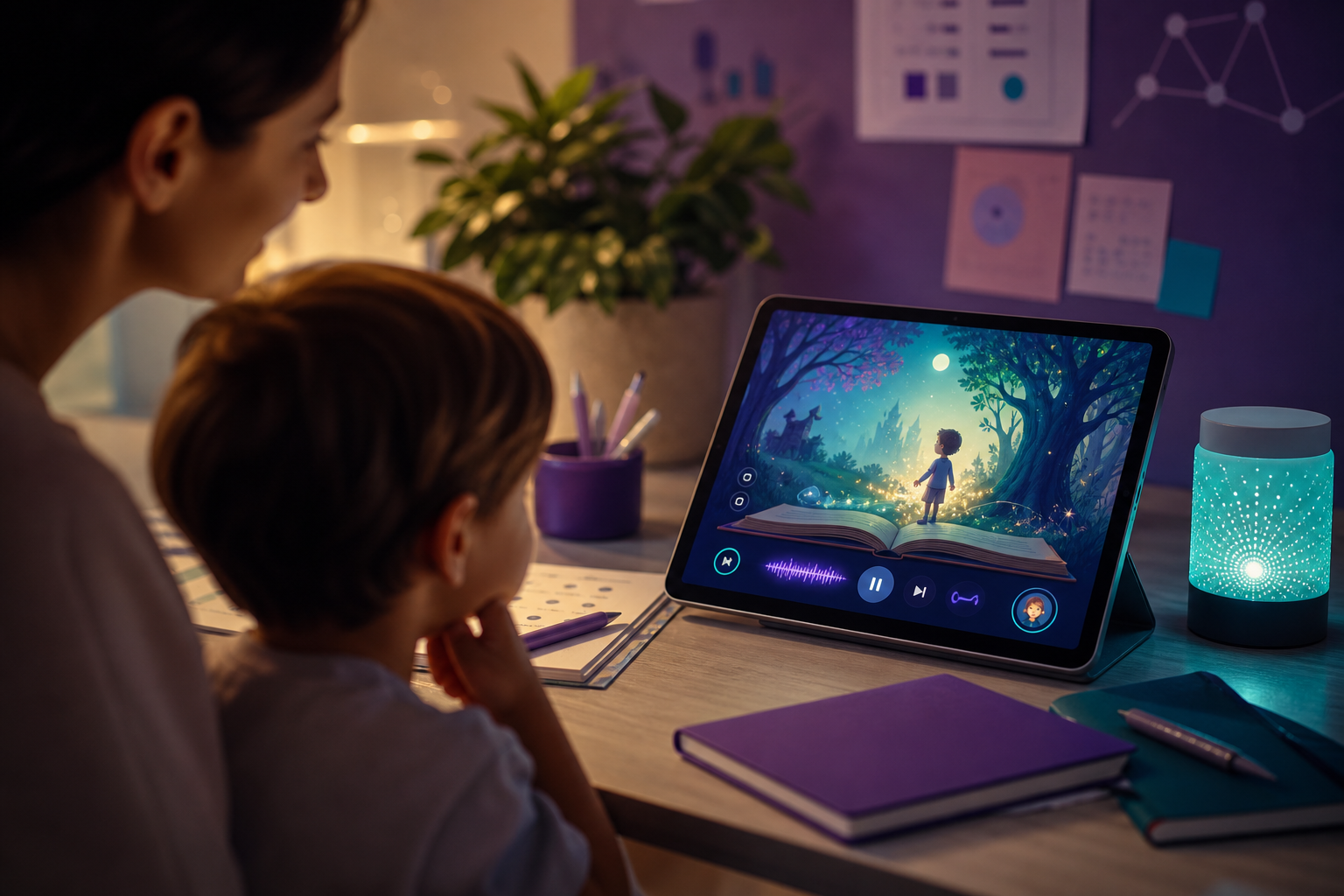
Early Academy’s publishing system is built around this distinction. The product is not a library of conventional videos. It is a catalog of short interactive storybooks where each page behaves like a living illustration. Characters may blink, breathe, wave, or move subtly; objects may respond when tapped; narration and audio clips can give the adult more material for conversation.
This study supports the product goal of using technology to enrich a bedtime story routine while keeping the adult-child relationship at the center.
What the study found
Interactive, technology-enhanced storytelling was associated with improved parent-child interaction quality and productive vocabulary in young children.
The positive value came from the way the technology shaped interaction, not from screen exposure as an isolated variable.
Well-designed media can provide prompts, structure, and shared focus for a caregiver and child.
How this supports Early Academy
The product is designed for co-viewing: a caregiver prompt accompanies the child-facing interaction.
Our story pages should be authored to create shared attention: an adult and child looking at the same scene, hearing the same narration, and responding to the same discoveries.
Subtle loops are appropriate because they keep the picture alive without turning the experience into a fast-cut video stream.
Hundreds of audio clips can be developmentally meaningful when they are attached to vocabulary, character emotion, story actions, and child-initiated exploration.
Product implications
Media should scaffold, not dominate
The app should give parents something to do, not remove them from the experience.
Motion should support attention
Loops should be slow and semantically meaningful: a candle flickers, a character waves, an animal breathes, a star glows. The motion should serve the story world.
Audio should be authored as pedagogy
Professional narration, object labels, character lines, and ambient sounds should be treated as part of the learning design, not as decorative noise.
Interpretation and limitations
The study does not prove that all interactive media benefits children.
The evidence supports careful technology-enhanced storytelling, especially when it increases parent-child interaction quality.