
Executive summary
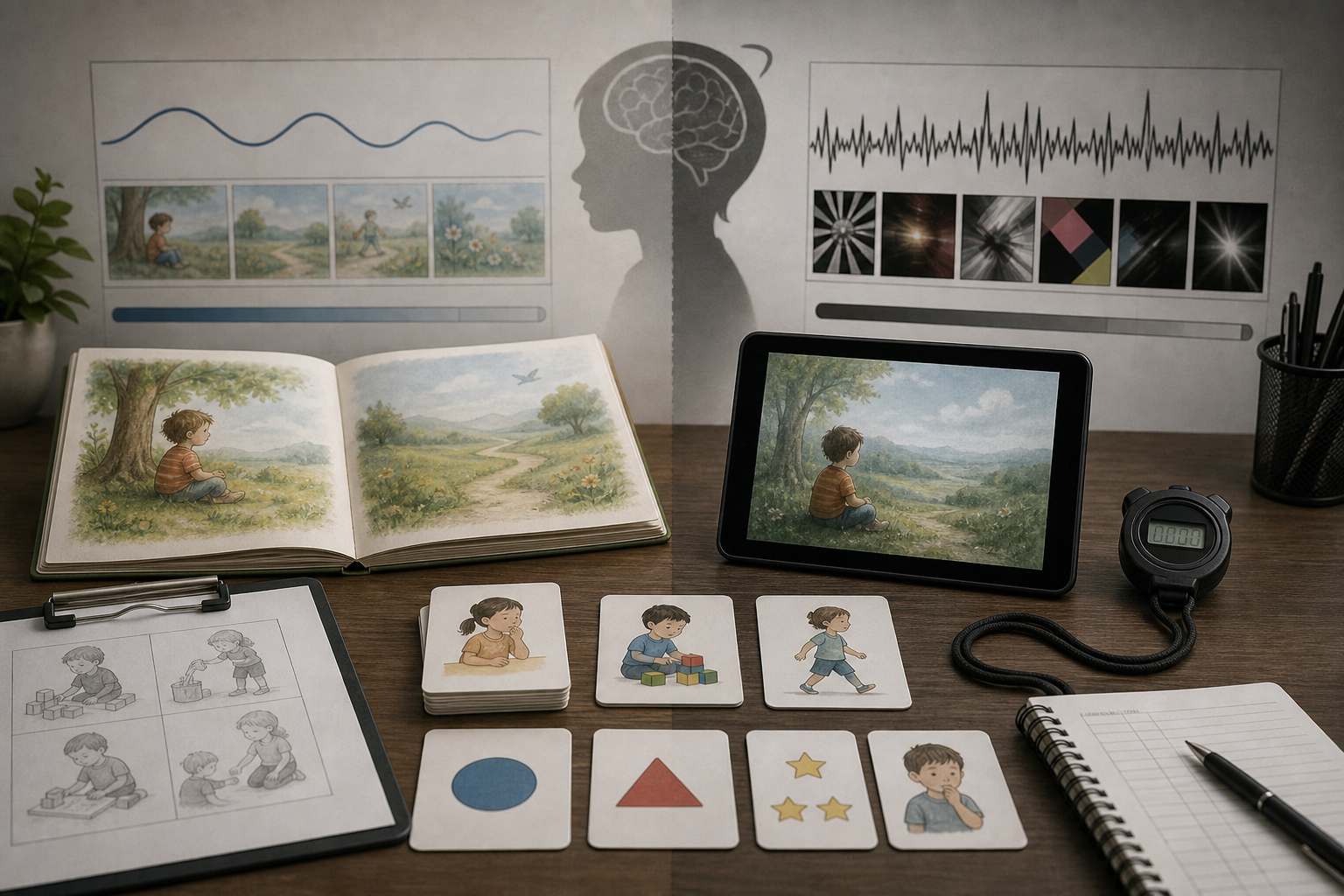
Lillard and Peterson’s Pediatrics study is one of the most directly relevant sources for Early Academy’s stance against rapid, high-stimulation video feeds. In the experiment, preschool children were randomly assigned to watch a fast-paced fantastical cartoon, watch a slower educational cartoon, or draw. After only nine minutes, the fast-paced group performed worse on executive-function tasks.
The study should not be overstated. It does not prove that every fast-paced children’s program causes long-term harm, and it does not evaluate Early Academy. But it does support a conservative design principle: for young children, media pacing matters. A product for bedtime and early learning should not rely on frantic cuts, constant zooms, and sensory novelty to hold attention.
Early Academy’s story pages are intentionally closer to illustrated pages with subtle living motion. The child can tap to discover what something is, hear a word, trigger a character line, or replay a sound. The attention loop is curiosity and participation, not rapid visual replacement.
What the study found
Sixty 4-year-olds were assigned to fast-paced television, educational television, or drawing.
Children in the fast-paced condition performed significantly worse on executive-function tasks than children in the other two groups.
The authors concluded that fast-paced television could at least temporarily impair young children’s executive function.
How this supports Early Academy
Early Academy avoids frantic cuts and constant novelty. Movement is subtle, story-driven, and paced so a child can stay engaged without being pulled through an endless stimulation drip.
Our app should communicate that it is not a video channel. It is an interactive storybook publishing system with subtle, page-based motion.
The study supports our decision to avoid fast-cut editing and constant novelty as the primary engagement mechanic.
The product’s bedtime positioning is important: the experience should help a child settle into a narrative, not escalate sensory demand.
Product implications
Prefer page-based pacing
Each page should remain stable long enough for the child to observe, listen, tap, and talk. Transitions should be intentional, not constant.
Use subtle loops
Motion should make the artwork feel alive without creating a rapid reward stream. Slow character movement, ambient animation, and gentle object responses are preferable to fast cuts.
Let the child initiate discovery
Tapping an object is more developmentally coherent than being pulled automatically through a sequence of sensory events.
Interpretation and limitations
The experiment measured immediate effects, not long-term outcomes.
The comparison involved specific types of television content, so the result should be used to support cautious pacing decisions rather than broad claims about all media.